CNMAT Research Group 2 Final Presentation 2026/04/29
InstructFX2FX:
Iterative Audio FX Refinement
via LLM + CLAP Optimization
Text-to-Preset Generation with Human-in-the-Loop Optimization
Group 2: Song-Ze Yu, Charlotte Zhang, Yuxuan Cai, Milan Liessens Dujardin
CNMAT, UC Berkeley
CNMATResearch Group 22026/04/29
The Problem: Sequential FX Refinement
Given existing parameters P, how can we use natural language instructions {I1, I2, ...} to make the sound better fit the user's needs?
  • Audio engineers iteratively refine FX parameters
  • Each instruction builds on existing state, not from scratch
  • No existing system handles multi-turn sequential refinement
Raw Audio + FX Params
Prompt 1: "make it warm"
Refined Params P'
Prompt 2: "too dark, brighter"
Refined Params P''
...
CNMATResearch Group 22026/04/29
Related Works
Text2FX
CLAP-guided optimization of FX parameters from text
Single prompt only
LLM2FX
LLM generates FX parameters from descriptors
Single prompt, no optimization
LLM2FX-tools (ICLR 2026)
LLM tool calls to select & order FX chain
Different problem: reverse engineering
FxSearcher
Bayesian optimization over CLAP for non-differentiable VST/AU plugins
Gradient-free, single prompt
Gap: No existing system combines LLM intelligence with gradient-based refinement for sequential prompting
CNMATResearch Group 22026/04/29
Our Hypothesis
LLM = The Brain
  • Selects which FX to apply
  • Orders the signal chain
  • Generates reasonable initial parameters
  • Audio engineering domain knowledge
+
CLAP = Ears + Hands
  • Perceives audio in embedding space
  • Gradient descent refines parameters
  • Moves sound toward target semantics
  • Perceptual loss, not numeric scoring
Combined: LLM provides the starting point, CLAP provides the refinement direction
CNMATResearch Group 22026/04/29
Introducing InstructFX2FX
Iterative text-to-preset refinement with persistent session state
InstructFX2FX (Ours)
Multi-turn refinement of audio FX presets: an LLM picks the FX chain and sensible starting parameters; CLAP-guided optimization adjusts the sound to match natural language step by step — built for sequential prompting and persistent session state, unlike pipelines that assume each text query is isolated (no accumulating FX preset).
  • LLM selects & orders effects; differentiable FX use gradient descent
  • Other effects use Bayesian optimization (same stack as FxSearcher-style search)
  • Session keeps accumulated parameters across user instructions
CNMATResearch Group 22026/04/29
Current Harness
Input
Dry Audio + User Instruction + Existing Params P
Layer 1
FX Selector Agent
Default: Gemini 3.1 Pro
Orchestrator
Merge Session FX + New FX
carry prior chain forward
Layer 2
Parser
reuse_all / initialize_all / reuse_and_initialize
Layer 3a
CLAP GD
EQ, Reverb
Layer 3b
Bayesian BO
Comp, Dist, Delay, PitchShift, Bitcrush
Output
Updated Params + Rendered Audio
Session Memory
history[] + current_params{}
church -> [rev]
add grit -> [rev, dist]
Layer 1 reads history.
Later turns reuse stored params.
Execution Rules
Turn 1 must pick at least one FX
Later turns can return []
Case 2 init only
Case 1 / 3 DASP first, then BO
CNMATResearch Group 22026/04/29
Layer 1: FX Selector Agent
  • Model is configurable; default is Gemini 3.1 Pro
  • Each FX is exposed as an add_<fx> tool
  • Tool call order = signal chain order
  • Tools already in the session chain are hidden on refinement turns
Initial Turn
Empty history
Clean "pick the chain" prompt.
tool_choice="required"
Input: "make it sound like a church"
Output: [add_rev]
Refinement Turn
History-aware add-only prompt
Sees prior prompts + current chain.
tool_choice="auto" so zero tool calls are allowed.
Current chain: [rev, dist]
Request: "too harsh, soften it"
Output: []
Available Tools
add_eq
add_comp
add_rev
add_dist
add_delay
add_pitchshift
add_bitcrush
What Changed From Last Version
  • Selector now reads session.history
  • Can decide to add nothing and just re-tune
  • Prevents double-adding an FX already in the chain
CNMATResearch Group 22026/04/29
Layer 2: Parser — Session-Aware Routing
The route now depends on whether the selected full chain already has params in the session
Case 1
All FX exist in session
Reuse existing params
Optimize
Case 2
No FX exist yet
LLM initialize all
Render once
Case 3
Mixed — some exist, some new
LLM init missing + merge
Optimize
Example: Case B from `tests/test_pipeline.py`
Turn 1: "make it sound like a church"
Full chain: [rev]
Case 2 → initialize reverb, then render once
Turn 2: "add some grit"
Full chain: [rev, dist]
Case 3 → reuse rev + init dist → optimize
Turn 3: "too harsh, soften it"
Full chain: [rev, dist]
Case 1 → reuse both → re-optimize
Current issue: BO does not reliably reduce distortion.
CNMATResearch Group 22026/04/29
Layer 3: Dual-Track Optimization
CLAP Gradient Descent DASP
For differentiable effects: EQ, Reverb
Params
DASP FX
Audio
CLAP
Loss
←←← Backpropagation ←←←
  • Adam optimizer, lr=0.01
  • Inverse-sigmoid param transform [0,1]
  • Configurable iterations (default 1000)
Bayesian Optimization Pedalboard
For non-differentiable effects: Comp, Dist, Delay, PitchShift, Bitcrush
Sample
Pedalboard
Audio
CLAP
Score
GP surrogate → LCB acquisition
  • scikit-optimize (gp_minimize)
  • LCB acquisition, kappa=5
  • Early stopping (30 iters no improve)
Sequential pipeline: DASP output audio → feeds as input to Pedalboard stage
CNMATResearch Group 22026/04/29
Loss Functions in CLAP Embedding Space
Directional Loss
A B text_dir audio_0 audio_t audio_dir parallel / align
If text moves A -> B, audio should move in the same direction.
text_dir = emb(B) - emb(A)
audio_dir = emb(audio_t) - emb(audio_0)
Semantic Similarity
audio target cosine sim
Direct similarity to target text
L = 1 - cos(audio, target)
Guided Semantic
audio target + negative −
Maximize target, minimize negative
L = 1 - cos(a,t+) + cos(a,t−)
t− = "harsh, distorted, muddy..."
CNMATResearch Group 22026/04/29
Demo
Live System Demonstration
Open Demo
Interactive: input audio + text prompt → optimized FX parameters
CNMATResearch Group 22026/04/29
Case Study: Case B
Routing works; distortion re-tuning is still weak.
Prompt 1
church
Prompt 2
add grit
Prompt 3
soften it
Turn 1 Result
["rev"]
Case 2 init only
Turn 2 Result
["rev", "dist"]
Case 3 add distortion
drive_db = 10.0
Turn 3 Result
["rev", "dist"]
Case 1 re-tune
distortion does not soften
drive_db stays 10.0
What works
  • Session carries the chain forward correctly
  • Refinement turn adds no extra FX
  • Parser lands on the reuse path
Main issue
  • BO is not pushing distortion downward
  • Movement happens mostly in reverb
  • Bottleneck looks like objective / CLAP, not routing
CNMATResearch Group 22026/04/29
Evaluation Setup
Dataset: SocialFX
7 EQ descriptor words
warm (93) bright (74) soft (74) loud (54) harsh (39) calm (26) heavy (25)
Selected by: count ≥ 20 AND consistency ≥ 0.45
10 Directed Word Pairs (A → B)
warm→bright
bright→warm
heavy→calm
heavy→harsh
harsh→soft
harsh→calm
warm→heavy
soft→loud
calm→loud
loud→heavy
Metric: MMD
Maximum Mean Discrepancy
  • 35-D DSP features (spectral, MFCC, temporal)
  • Gaussian kernel, median bandwidth
  • Lower = closer to GT distribution
Ground Truth Construction
Dry Audio
Apply EQA
Apply EQB
Sequential GT: Audio with params_A then params_B
50 random samples per word per instrument
CNMATResearch Group 22026/04/29
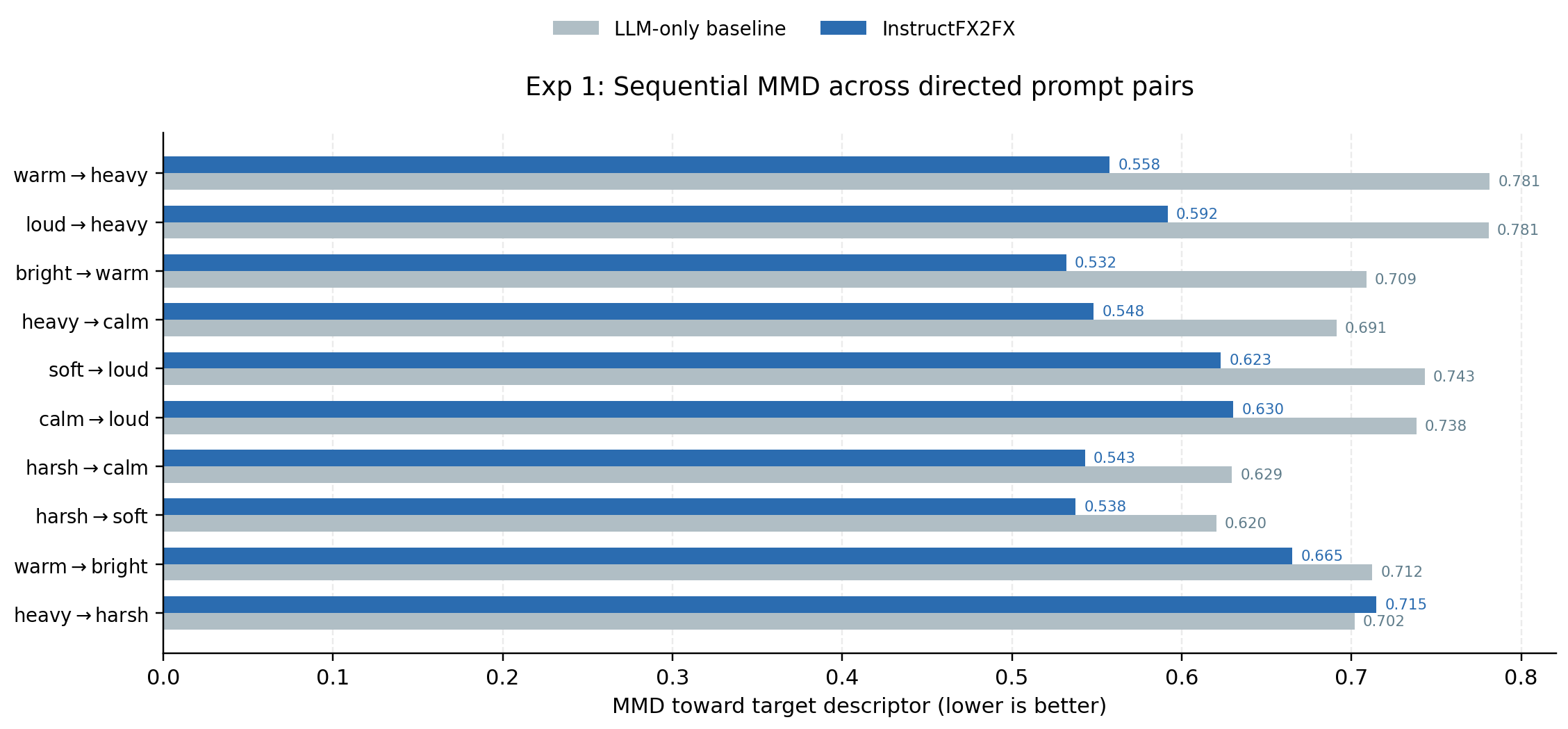
Exp 1: Sequential MMD
System output vs. sequential ground truth — lower MMD is better
MMD Comparison: InstructFX2FX vs LLM-only Baseline
Exp 1 Sequential MMD results
90%
word pairs improved
(9 / 10)
Key Finding:
CLAP gradient descent consistently outperforms LLM-only reprompting across 9 of 10 directed word pairs.
Only heavy→harsh slightly regresses (0.715 vs 0.702).
CNMATResearch Group 22026/04/29
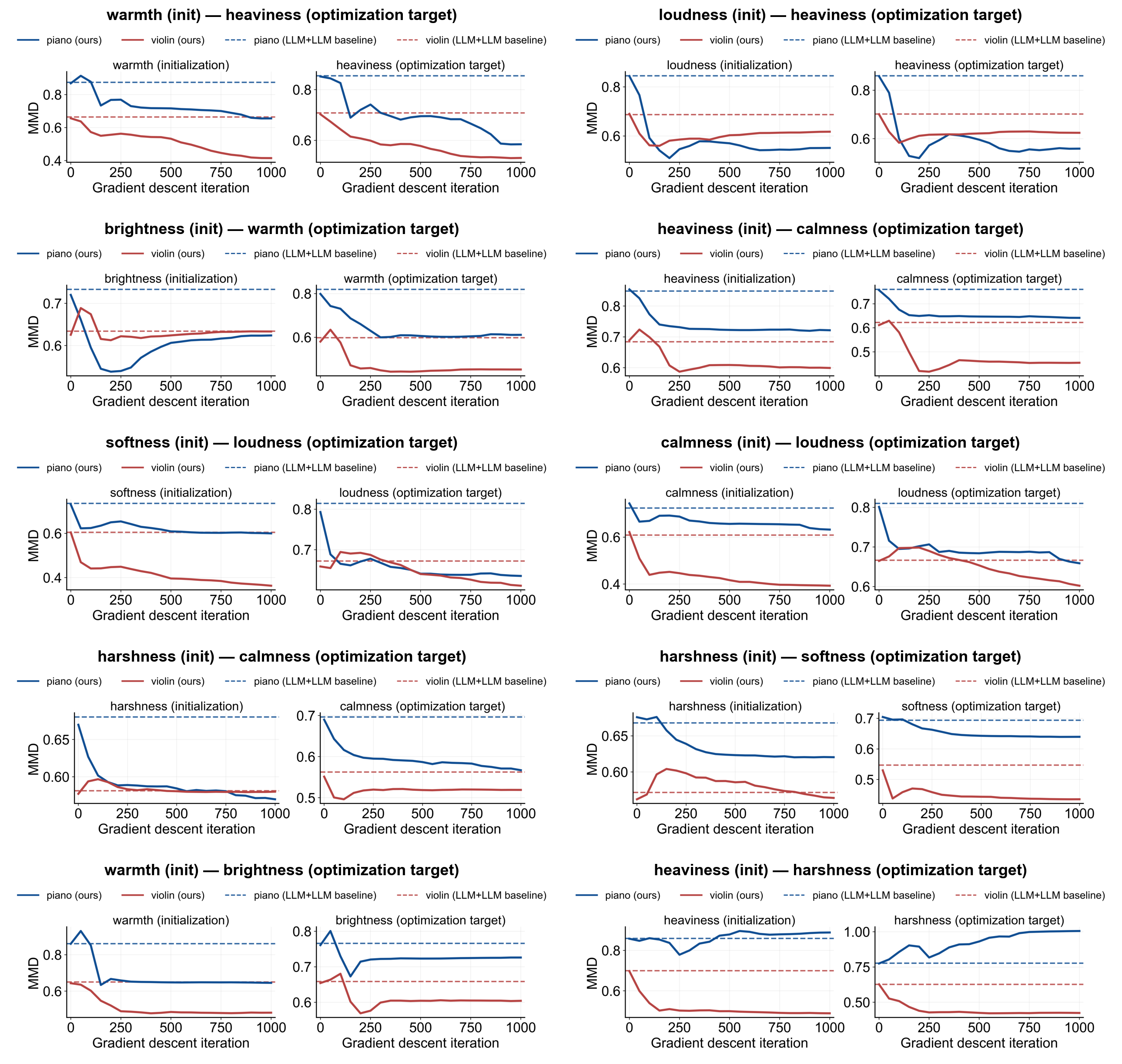
Exp 2: MMD Convergence Trajectory
Good case — loud → heavy (both instruments stay below baseline)
loud to heavy trajectory
Messy case — calm → loud (violin: above baseline on loud panel ~0–400 iters)
calm to loud trajectory
What works
  • Sharp drop early; often below LLM+LLM baseline
Where it struggles
  • Overshoot / drift later in optimization
  • CLAP objectives don’t match DSP-feature MMD
CNMATResearch Group 22026/04/29
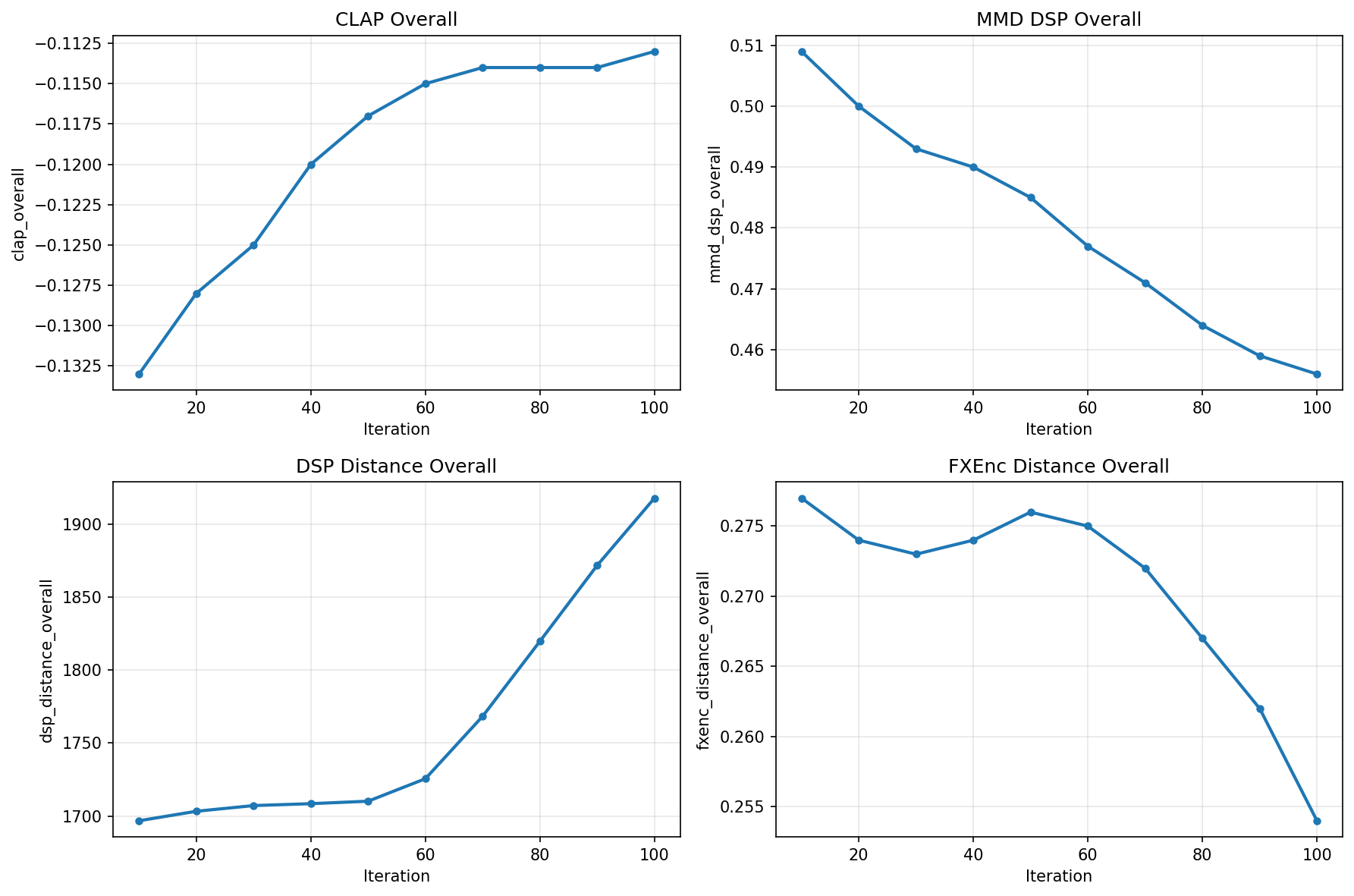
Exp 5: LLM Initialization Ablation
Does CLAP refinement actually help beyond LLM initialization? — "bright" target, piano
CLAP score, MMD, DSP & FXEnc distance across 100 optimization iterations
Exp 5 trajectory plot
CLAP ↑ monotonically; MMD DSP ↓ converges toward GT; FXEnc ↓ stabilizes after iter 60
DSP distance ↑ throughout — CLAP optimization and DSP features are not always aligned
CNMATResearch Group 22026/04/29
How We Got Here
Research arc: judge loops → optimization → InstructFX2FX
Phase 01
v1 Judge loop
LLM emits FX presets; separate judge scores outputs; reprompt on low score.
Roadblock
Judge fails
Noisy descriptors; no fair numeric “warm” score; LLM reprompts don’t converge.
Pivot
Reframe goal
Stop judging absolutes — move audio toward user intent.
v2 Optimize
Human-in-the-loop
Text2FX-style CLAP tuning: you listen and steer with NL feedback, not a brittle judge. One effect chain.
Now
InstructFX2FX
1. SocialFX MMD / PCA evaluation
2. harness of the architecture
3. demo website
Fall ’25
Fall ’25
Nov ’25
Dec ’25
Spring ’26
CNMATResearch Group 22026/04/29
Limitations & Future Work
Current Limitations
  • EQ-only evaluation (SocialFX dataset constraint)
  • CLAP embedding space may not capture all timbral nuances
  • Pedalboard effects use BO (slower, non-differentiable)
  • Fixed negative anchor in guided loss
  • Convergence speed: several seconds per optimization
Future Directions
  • Multi-effect evaluation (comp, reverb, distortion)
  • Human listening study for perceptual validation
  • Fine-tuned CLAP for audio FX domain
  • Real-time interactive interface
  • DAW plugin integration (VST/AU)
CNMATResearch Group 22026/04/29
Thank You!
Group 2: Song-Ze Yu, Charlotte Zhang, Yuxuan Cai, Milan Liessens Dujardin
CNMAT, UC Berkeley
Questions?
1 / 19
Best viewed on a desktop or laptop — rotate to landscape for a better experience